






LIGHT, PRESENCE AND INTERIOR SPACES

Light as a modulator of attention
Light does not simply illuminate space. It directs attention within it.
Candlelight operates at a human scale. Its intensity is limited, its reach contained. Rather than distributing light evenly, it creates zones of focus. Attention gathers where the flame is present, while the surrounding space recedes.
This modulation is central to presence. By narrowing the field of perception, candlelight reduces dispersion and allows attention to settle.

Presence as a spatial condition
Presence is often described as a mental state. In practice, it is also a spatial condition.
The way a space is lit influences how it is perceived and inhabited. Candlelight alters this relationship by slowing visual rhythm. Shadows soften edges. Volumes appear less absolute. Space becomes less directive, more receptive.
This shift does not add information. It removes excess, allowing occupants to remain with what is immediately perceptible.

The perception of volume and depth
Unlike uniform lighting, candlelight reveals space selectively.
Walls, ceilings and objects are not flattened by brightness. Depth is reintroduced through contrast. The eye moves more slowly, adjusting continuously. Volumes are perceived through gradation rather than outline.
This dynamic perception changes how a space is experienced. It becomes less about measurement and more about relation.

Rhythm and temporal awareness
Candlelight introduces rhythm into space.
The flame moves subtly. Its light fluctuates within a narrow range. This continuous but restrained motion establishes a temporal presence. Time becomes perceptible without being quantified.
This rhythm influences how long one remains in a space and how that time is felt. The environment encourages pause rather than passage.
The candle as an anchor
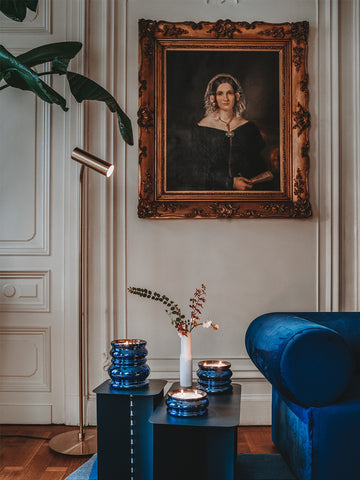
Within an interior, a candle functions as an anchor point.
It does not organise space through symmetry or alignment, but through gravity of attention. The flame establishes a centre without imposing hierarchy. Objects and people orient themselves in relation to it, consciously or not.
This anchoring effect contributes to coherence. The space feels held rather than arranged.

Light shaping use and experience
Candlelight does not decorate space. It conditions use.
Its presence influences posture, distance and interaction. Conversations slow. Movements become measured. The space adapts to the light rather than the reverse.
This relationship is functional in a broader sense: it governs how space is inhabited, not how it appears.