






CANDLELIGHT AS RITUAL

Light before function
Long before light became a technical solution, it was a ritual gesture.
Candlelight was not introduced to optimise visibility. It marked moments, structured time and created presence. Its value lay less in what it illuminated than in the atmosphere it shaped.
In this sense, candlelight precedes function. It establishes a state rather than solving a problem.

Ritual as a structure of time
Ritual does not belong to folklore. It is a human way of giving form to time.
Lighting a candle introduces a threshold. It signals a shift from movement to stillness, from noise to quiet focus. The gesture is simple, yet its effect is immediate and perceptible.
Ritual creates a beginning. Extinguishing the flame creates an end. Between the two, time unfolds with different density.

The gesture and its meaning
The act of lighting a candle is deliberate. It requires pause, attention and intention.
Unlike automated light, candlelight invites participation. The flame is not activated; it is received. In that moment, a subtle connection emerges between the visible space and the surrounding silence, between the individual and what extends beyond the immediate.
Meaning arises not from symbolism, but from repetition. Across cultures and contexts, the same gesture produces similar conditions of calm, focus and shared awareness.

Light that gathers rather than dominates
Candlelight does not flood space. It gathers it.
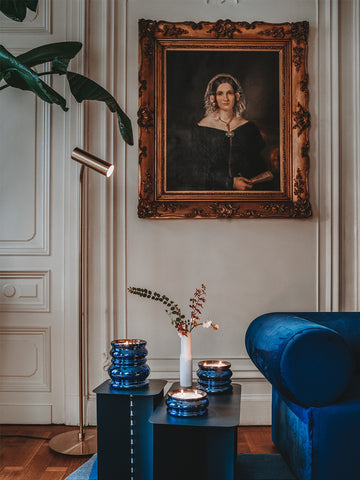
The flame creates a limited field of attention. Its light is not fixed but gently moving, almost breathing with the air around it. Faces, objects and surfaces appear within a shared radius, encouraging proximity rather than distraction.
For this reason, candlelight accompanies moments of contemplation, conversation and quiet gathering. It creates atmosphere without imposing it.
Silence, slowness and presence
The flame introduces slowness without instruction.
Its movement is continuous yet restrained. Its duration is finite. It reminds those present that time is passing, yet not rushing. Candlelight does not accelerate experience; it anchors it.
Silence, when it emerges around candlelight, is not imposed. It is allowed to settle.

A universal ritual, not a belief
Candlelight functions as ritual across cultures because it is not confined to doctrine.
It appears in moments of remembrance, celebration, waiting, gathering and solitude. Its meaning adapts to context while maintaining coherence. What remains constant is its capacity to mark significance without explanation.
Ritual here is not symbolic excess. It is structural clarity.

The place of Hoogeland 1770
As a Dutch family candle house founded in 1770, Hoogeland 1770 emerged in a context where candles first accompanied communal and ecclesiastical spaces.
From the beginning, light was associated with reflection, gathering and shared silence. Over time, this understanding extended beyond any single setting. The house approaches candlelight not as decoration, but as a medium that shapes time, space and presence.
In this context, candlelight is not an accessory. It is a ritual condition, quiet, human and enduring.